Why Door-to-Door EV Charging Is Transforming Urban Mobility
Cities were built for horses, then cars, then congestion. Electric vehicles promise cleaner air and quieter streets, yet urban infrastructure lagged behind adoption for years. Today, millions of city dwellers drive EVs without guaranteed access to a private charger. This mismatch between vehicle technology and urban living conditions has created demand for an entirely new category of service: door-to-door EV charging.
Urban mobility always involved trade-offs. Space is scarce. Parking is contested. Time is expensive. Traditional charging models — assuming a driveway and a wallbox — exclude a large proportion of city residents. Public charging was supposed to fill the gap. In practice, urban drivers report spending disproportionate time locating working chargers, navigating payment systems, and waiting while others finish sessions.
The Urban Charging Challenge
Consider a typical scenario in London, Manchester, Birmingham, or Edinburgh. You live in a Victorian terrace or modern flat. Your car sits on the street or in a shared car park without dedicated charging. Your employer offers no workplace chargers. Supermarket rapid units are occupied when you arrive. The nearest reliable charger requires a fifteen-minute detour — each way.
Multiply that friction across a week, a month, a year. Hours disappear. Stress accumulates. Some drivers report range anxiety not because their battery is inadequate but because charging logistics feel unpredictable. This is an infrastructure problem disguised as a technology problem.
Local authorities have responded with lamppost chargers, on-street bays, and planning requirements for new developments. Progress is real but uneven. Installation timelines stretch across years. Maintenance quality varies. Not every street receives investment simultaneously. Urban EV owners cannot wait for perfect infrastructure — they need solutions that work today.
What Door-to-Door Charging Delivers
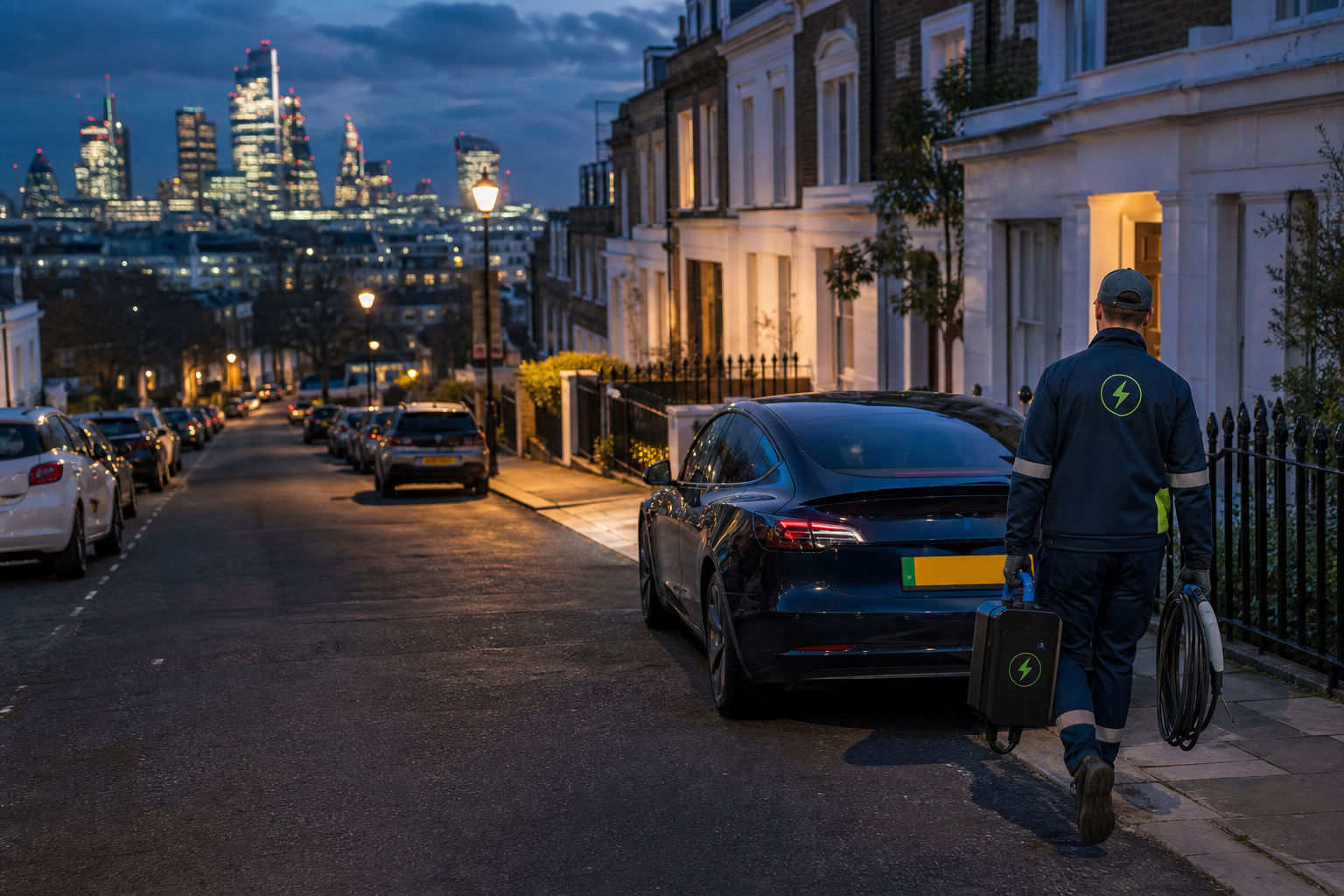
Door-to-door EV charging inverts the traditional model. Instead of the driver going to the charger, the charging comes to the driver — or more precisely, the service collects the vehicle and handles everything remotely. You book online or via messaging apps. A professional driver arrives at your location, collects your keys or uses contactless handover protocols, and transports your vehicle to a charging facility.
While you sleep, work, attend meetings, or enjoy dinner, your EV charges to your requested level. Notifications confirm collection, charging progress, and return timing. Your vehicle arrives back at your doorstep — or office, hotel, or airport car park — ready for the next journey. Comprehensive insurance covers the entire process.
This model eliminates the urban driver's core frustrations. No circling blocks searching for bays. No standing in rain at motorway services. No disputes over occupied chargers. No juggling multiple network apps with different pricing and connector types. The service absorbs complexity; the customer receives simplicity.
Who Benefits Most in Cities
Professionals with demanding schedules represent a primary audience. Consultants, lawyers, healthcare workers, and executives measure time in billable hours and appointment slots. An hour lost to charging logistics carries real economic cost. Concierge services convert that hour into productive or restorative activity.
Hotel guests form another key segment. Business travellers increasingly arrive by EV. Hotels rarely provide adequate charging for every guest. A concierge partner can charge vehicles overnight and deliver them ready for departure — a premium amenity that enhances guest satisfaction without capital investment in on-site infrastructure.
Airport parking presents a third opportunity. Travellers flying for business or holiday often leave vehicles for days. Battery drain from security systems and ambient conditions reduces range upon return. Charging during absence ensures a fully powered welcome home — particularly valuable after long flights when energy for navigation and family commitments matters.
Urban families without driveways benefit throughout daily life. School runs, grocery trips, and weekend activities depend on reliable transport. Knowing charging is handled professionally removes a persistent source of household stress.
Environmental and Social Considerations
Concierge services can optimise charging location and timing for grid efficiency. Centralised charging at professional facilities may utilise off-peak electricity more consistently than scattered public sessions. Fleet routing for collection and return can be optimised to minimise empty miles as services scale.
Social equity questions deserve attention. Premium services must not become the only viable option for urban residents excluded from home charging. Responsible operators work alongside public infrastructure investment rather than replacing it. Door-to-door charging complements lamppost units and workplace schemes — it does not eliminate the need for accessible public networks.
From an emissions perspective, any solution that makes EV ownership practical for urban households accelerates transport decarbonisation. Drivers who might hesitate to switch citing charging uncertainty become willing adopters when concierge options exist. Faster adoption delivers air quality improvements cities urgently require.
Technology Enabling the Model
Modern concierge operations rely on integrated booking platforms, real-time tracking, secure key exchange, and customer communication tools. GPS routing optimises driver efficiency. CRM systems maintain service history and preferences. Payment processing supports subscriptions, one-off bookings, and corporate accounts seamlessly.
Vehicle compatibility has expanded as EV market share grows. Services train drivers on diverse manufacturers, connector types, and handling requirements. Insurance products evolve to cover professional EV transport. Regulatory frameworks in the UK generally support vehicle collection services when operators meet licensing and insurance standards.
Customer expectations shaped by food delivery and ride-hailing apps transfer to charging. Transparency, punctuality, and communication quality determine satisfaction. Operators who excel in service design build loyal subscriber bases and strong referral networks.
Economic Viability and Pricing Trends
Early sceptics questioned whether concierge charging could price competitively. Market development suggests tiered offerings serve different segments effectively. One-off bookings command premium rates justified by convenience. Subscription packages reduce per-session cost for regular users. Corporate fleet arrangements offer volume pricing for businesses managing multiple vehicles.
When calculating value, urban drivers should compare total cost of ownership including time. Public charging pricing plus parking fees plus opportunity cost of waiting often approaches concierge rates — without guaranteed outcomes. Home charging remains cheapest where available but irrelevant where impossible.
Looking Ahead
Door-to-door EV charging will not replace every other model. It will become a standard option in the urban mobility toolkit — as normal as car washes, valet parking, and delivery services already feel. Cities that embrace diverse charging solutions accelerate EV adoption. Drivers who discover concierge services rarely return to the anxiety of unreliable public queues.
AutoRecharged built its service around this urban reality. We collect, charge, and return — so city drivers focus on living, working, and connecting rather than hunting electrons. The future of urban mobility is electric. Door-to-door charging ensures that future includes everyone, not just those fortunate enough to own a driveway.