The Complete Guide to EV Charging: Home, Public, and Concierge Services Compared
Electric vehicles have moved from niche curiosity to mainstream choice. In the UK alone, hundreds of thousands of drivers now rely on battery power for their daily commute, family trips, and business travel. Yet one question continues to dominate conversations in driveways, office carparks, and online forums: what is the best way to keep an EV charged?
The answer is not as simple as plugging in a phone overnight. Charging infrastructure, vehicle technology, driving habits, and property type all influence which approach works best. This guide examines every major option — home charging, workplace charging, public networks, and concierge services — so you can make an informed decision that suits your lifestyle.
Understanding How EV Charging Works
Before comparing options, it helps to understand the basics. Electric vehicles store energy in lithium-ion battery packs measured in kilowatt-hours (kWh). Charging speed depends on the power delivered, measured in kilowatts (kW). A 7 kW home charger adds roughly 25–30 miles of range per hour for most vehicles. A 50 kW rapid charger can deliver a significant boost in under an hour. A 150 kW ultra-rapid unit can charge compatible vehicles even faster.
Most daily driving in the UK covers fewer than 30 miles. That means a full overnight charge at home satisfies the majority of journeys. However, not every driver has a driveway, not every charger works reliably, and not every schedule allows time to hunt for an available public unit. These realities explain why the charging conversation has become so complex — and why new solutions continue to emerge.
Home Charging: The Default Choice
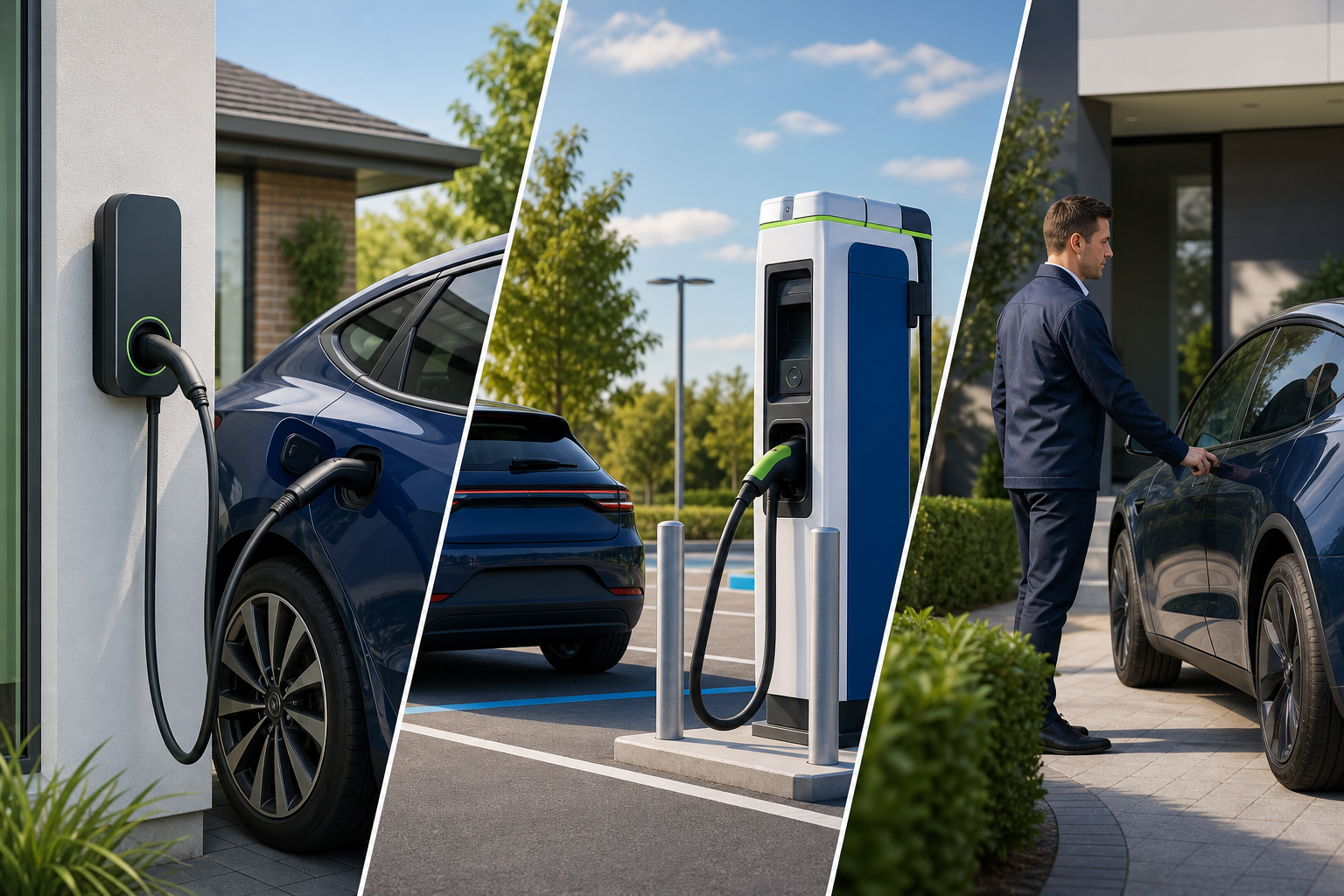
Home charging remains the gold standard for EV owners with off-street parking. A dedicated wallbox connected to your domestic supply allows you to charge overnight when electricity tariffs are often cheapest. Government grants have historically supported installation costs, and smart chargers can schedule sessions to minimise bills.
The advantages are clear. Convenience ranks first: you arrive home, plug in, and wake up to a full battery. Cost efficiency follows, especially on off-peak tariffs. There is no queue, no app juggling, and no detour required. For families with predictable routines, home charging delivers unmatched simplicity.
However, home charging has limitations. Installation requires suitable electrical infrastructure. Listed buildings, rented properties, and flats without dedicated parking often face barriers. Even homeowners may wait weeks for electrician availability. Maintenance falls on the owner, and if the charger fails on a Sunday evening before a Monday trip, stress levels rise quickly.
Home charging also assumes you spend most nights at the same address. Frequent travellers, shift workers, and those splitting time between locations may find a home charger insufficient on its own. In these cases, supplementary options become essential rather than optional.
Public Charging Networks
Public charging infrastructure has expanded dramatically across motorways, retail parks, supermarkets, and urban centres. Major networks operate contactless payment, mobile apps, and membership schemes. Rapid hubs along A-roads support long-distance travel, while slower destination chargers serve restaurants and hotels.
Public charging shines during road trips and for drivers without home charging access. A well-maintained rapid charger can transform a coffee break into a meaningful range top-up. Destination charging while shopping or dining adds convenience without extra time cost.
Yet public charging frustration is well documented. Out-of-service units, slow speeds compared to advertised rates, incompatible connectors, and occupied bays create real-world headaches. Pricing varies wildly between networks and locations. Some drivers report spending more time managing apps and memberships than they save at the plug.
Reliability remains inconsistent. Industry data suggests a meaningful percentage of public chargers may be unavailable at any given time. For drivers with tight schedules — parents on the school run, professionals between meetings, carers on call — uncertainty is unacceptable. Public charging works best as a backup or supplement, not always as a primary strategy.
Workplace Charging
Employers increasingly install chargers to support staff and meet sustainability targets. Workplace charging effectively doubles daily range for commuters who plug in during office hours. For businesses with fleet vehicles, on-site charging is often essential.
The model suits employees with regular office attendance. Hybrid workers may find chargers occupied by colleagues. Not all employers offer the benefit, and access rarely extends to evenings or weekends. Still, for those who have it, workplace charging reduces home electricity use and provides peace of mind during the working day.
Concierge and Door-to-Door EV Charging
Concierge EV charging represents the newest category — and the one growing fastest among time-conscious drivers. Rather than travelling to a charger, you book a service that collects your vehicle, charges it at a professional facility, and returns it fully charged to your chosen location.
Services like AutoRecharged eliminate queue anxiety entirely. There is no searching for available bays, no incompatible hardware, and no waiting on forecourts. Professional drivers collect your EV from home, work, a hotel, or an airport car park. You receive updates throughout the process. Your vehicle returns at the charge level you specify, fully insured throughout.
Concierge charging suits busy professionals who value time over marginal cost savings. It supports hotel guests arriving with low battery, airport travellers who cannot charge before a flight, and urban residents without driveways. Subscription packages make regular use affordable for frequent drivers.
The trade-off is cost compared with home charging on off-peak tariffs. Concierge services charge for convenience, insurance, professional handling, and guaranteed outcomes. For many drivers, that premium delivers value measured in hours reclaimed and stress avoided — a calculation that increasingly favours door-to-door solutions.
Making the Right Choice for Your Situation
Consider your parking situation first. Driveway owners benefit most from home charging supplemented by public rapid chargers for long trips. Flat residents without assigned parking may rely on public networks or concierge services exclusively. Frequent travellers should evaluate airport and hotel charging partnerships.
Analyse your weekly mileage and schedule. Predictable routines favour home charging. Irregular patterns favour flexibility. Calculate the true cost of public charging including membership fees, idle time, and failed sessions — not just the pence per kWh displayed on the app.
Factor in reliability requirements. If a missed charge means a missed meeting, flight, or appointment, guaranteed services outperform probabilistic public networks. Insurance and professional handling matter when handing over a valuable vehicle.
The Future of EV Charging
Industry trends point toward greater diversity rather than a single winning model. Home charging will remain dominant where infrastructure allows. Public networks will continue expanding with improved reliability mandates. Vehicle-to-grid technology may eventually turn parked EVs into grid assets. Concierge and mobile charging services will fill gaps that fixed infrastructure cannot address efficiently.
For today's driver, the smartest approach is often hybrid: home charging where possible, public networks for journeys, and concierge services when convenience and certainty matter most. Understanding all options empowers you to choose confidently — and to enjoy electric driving without the hassle that too many still associate with keeping a battery full.